
We’re joining the Archives of Ontario in its month-long #ArchivesAtoZ campaign. The aim is to increase the public’s awareness of archives and their collections. We’ll be sharing four posts throughout this month showcasing items from our holdings or providing information about Archives terminology based on each letter of the alphabet.
This week we will finish the alphabet! We hope you’ve enjoyed learning a little more about your Diocesan Archives.
T – Trowels
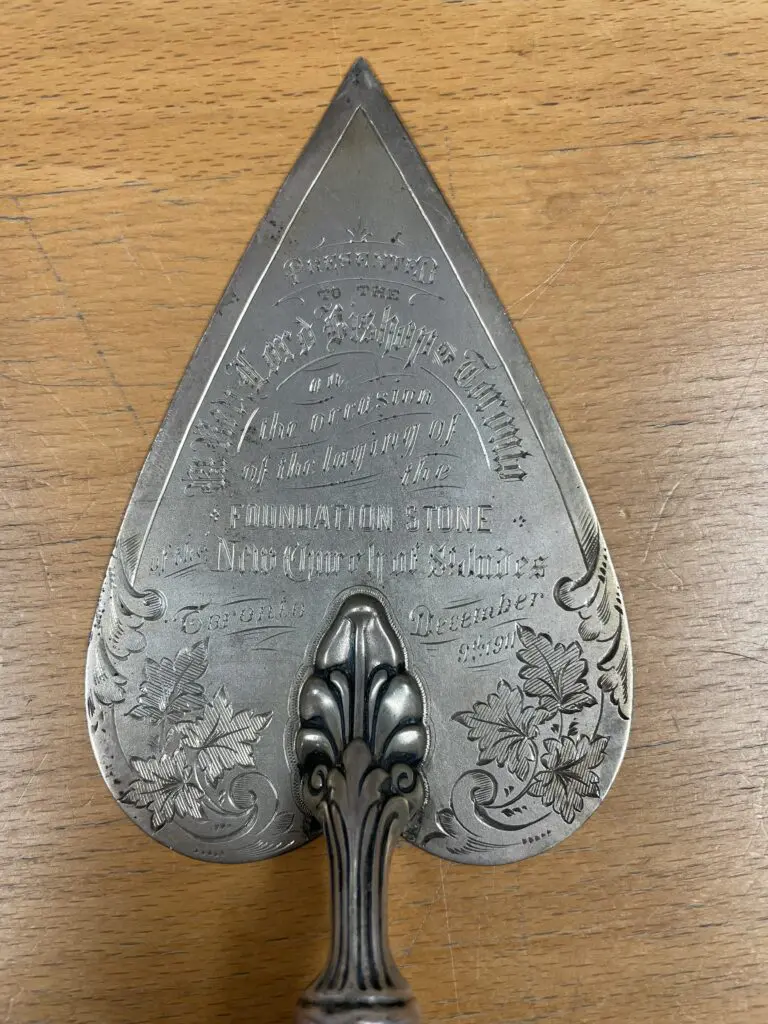
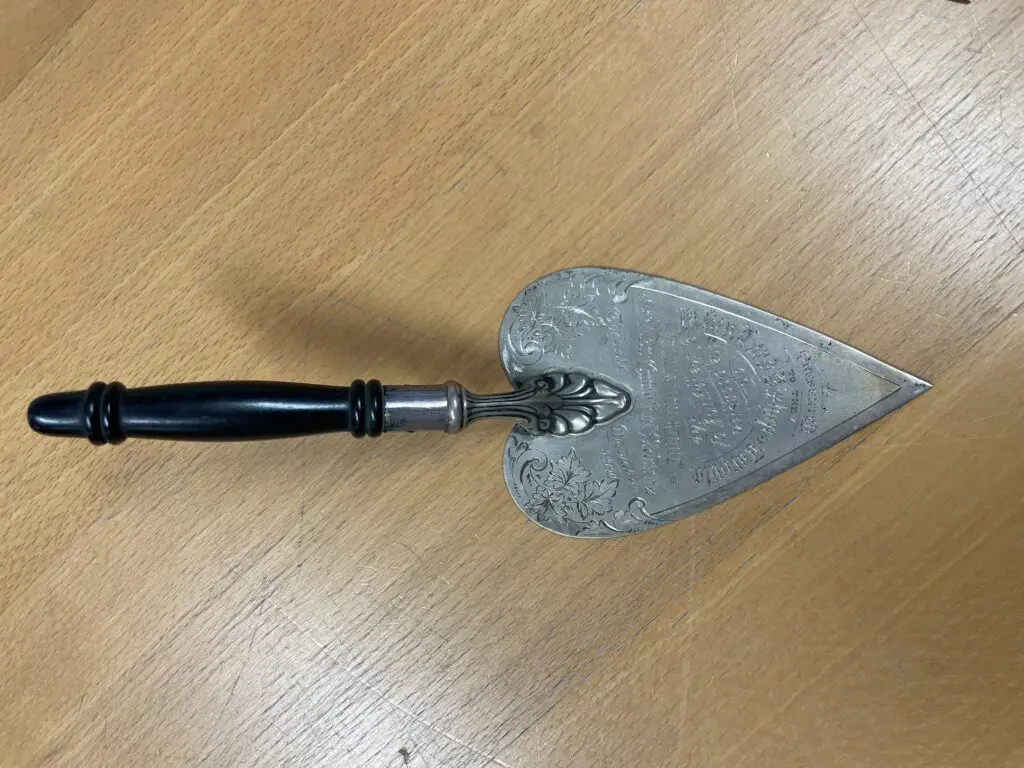
While the Diocesan Archives doesn’t accept all artifacts, we do accept ceremonial trowels from the laying of cornerstones. These are often presented to the bishop at the ceremony of laying of the cornerstone for a new building or an addition.
There are 10 trowels in our collection, with the earliest from 1880s. The majority of the collection come from the 1910s when the diocesan bishop was the Most Rev. James Fielding Sweeney. These include the trowel from the laying of the foundation stone for the new church of St. Jude, Roncesvalles, their original church becoming the parish hall. A nice connection to have to these trowels is a copy of the order of service from this special event that happens in the life of a parish.
U – Unprocessed
One of the struggles that many archives face at one time or another is a backlog of accessions to be formally processed. The aim is to create a basic listing of records received as soon as possible after records are received, but processing involves reviewing the contents of files to ensure the listing is as accurate and detailed as possible at the file level. This also includes reviewing for duplicates and records that are not archival, as well as rehousing the records into acid-free folders for long-term preservation.
This level of processing generally takes 4-6 hours per linear foot. When a church closes, the Archives can receive up to 10 bankers boxes of records to be reviewed for archiving, along with financial records on a retention schedule that need to be managed on an annual basis. Due to the volume of records from these closed churches, there are still some unprocessed records.
V – Volunteers
The Diocese relies on volunteers at all levels, from the parish to the Synod Office. The Diocesan Archives has been fortunate to find some wonderful volunteers over the years to help us to complete projects that will make our collections more accessible. We truly value the contributions they make to our work ,and I appreciate this opportunity to acknowledge past volunteers David Ptolemy, ODT, Dorothy Kealey, ODT and Caese Levo, as well as our current volunteers David, Kirin, Bonnie, Lorna, Dawn and Paul at the Diocesan Archives and Rebecca, Anne and Nancy, with the St. James Archives records.
 Many parishes also maintain some level of archives, and these are usually managed by volunteers. One well-known parish archivist was Nancy Mallet, ODT at St. James Cathedral. She managed the cathedral archives from 1998 until she turned 90 in 2020, and she gave many hours to make sure key records were transferred to the archives and preserved. In 2020, the Diocesan Archives took on managing the cathedral archives, and we hope to find the funding to be able to fulfill Nancy’s wish to install mobile shelving in that space. Nancy recently died at the age of 96, and she is missed not only by our Archives but by her parish community and by the wider community to which she gave so much of her time and energy.
W – Windows
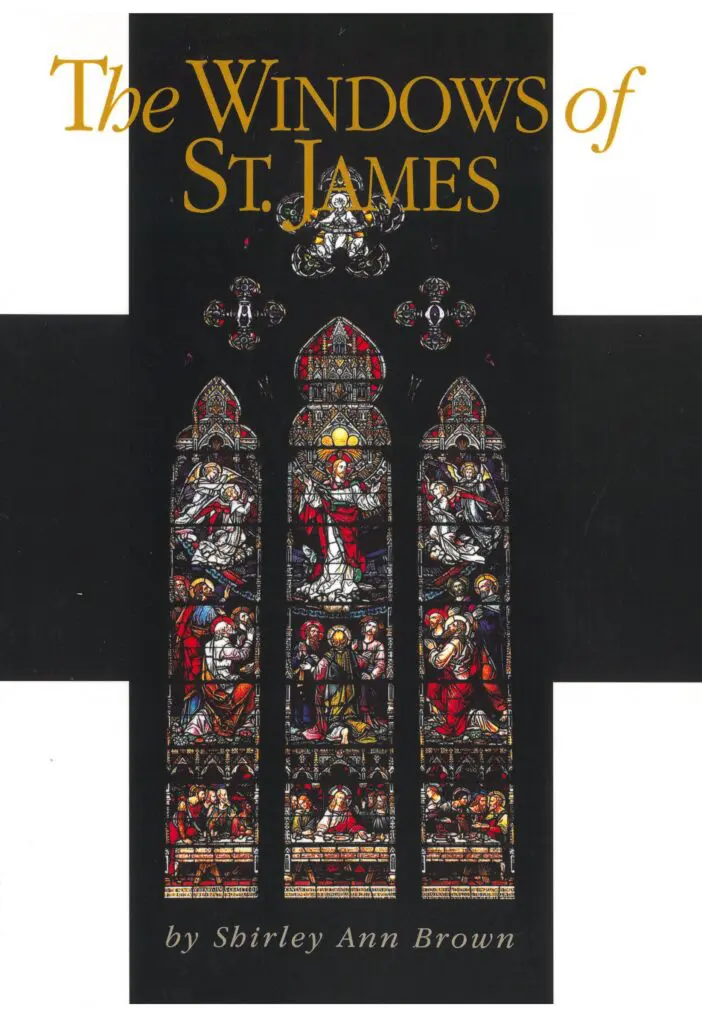
Most churches have some form of stained-glass windows and although the Diocesan Archives can’t accept actual stained-glass windows, there are records within the fonds of a number of parishes and congregations related to these windows. These records may include information about the designers of particular windows, who donated the window, who the window was in memory of or how much it cost.
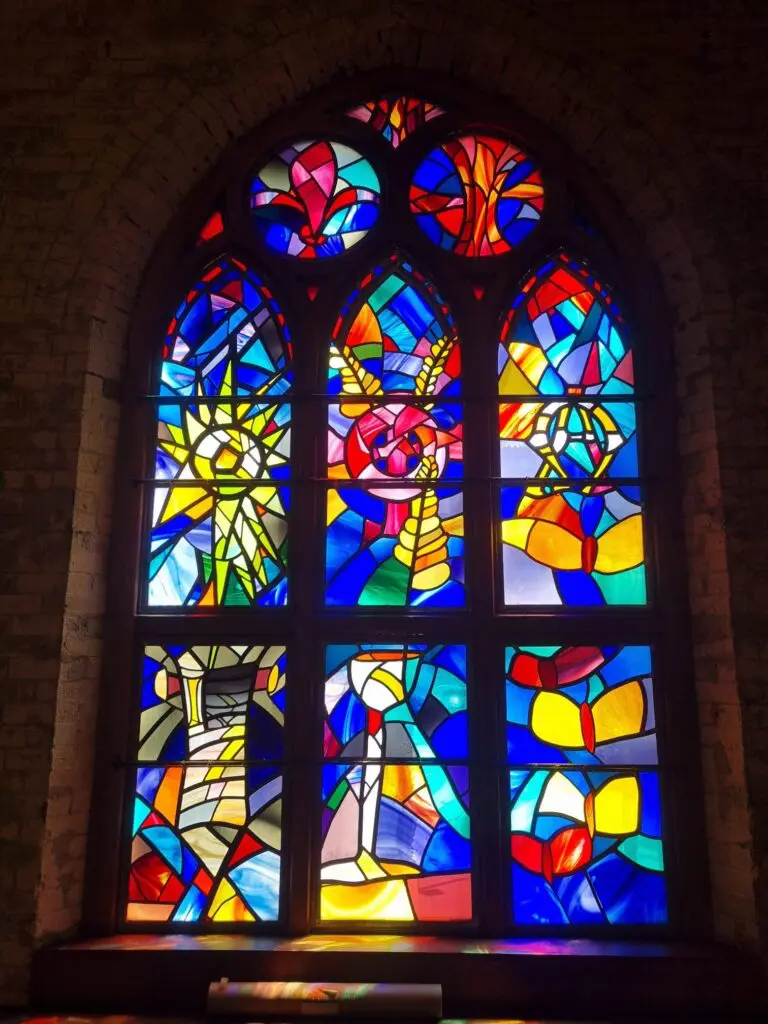
Several congregations have included information about the windows in their churches in pamphlets or booklets, and these have been added to our collections. However, sometimes we are contacted about a window and can’t find any information in the records. It would be wonderful if congregations would take good quality photographs of their windows and send copies along with any information about the windows that they have to the Archives so that we might develop a database of all the stained glass windows in the Diocese. It would also allow for the ability to see the wide ranging variety of window designs that exist within the churches of the Diocese of Toronto.
 \
\
X – uXbridge
We are taking some liberties with the letter X and sharing about a place that has an X in the name.
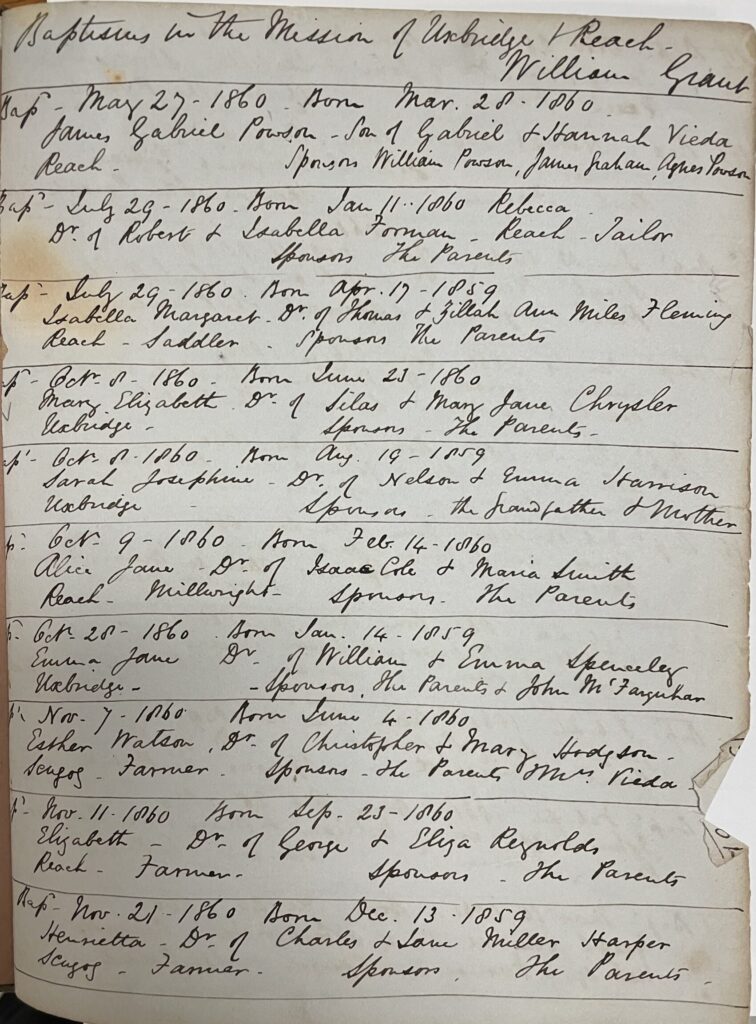
The first services in Uxbridge began in 1834 and were held on an intermittent basis, first in a barn and then in a schoolhouse. These services were led by travelling missionaries, including the Rev. Adam Ellliot between 1834 and 1839 and the Rev. R.J.C. Taylor, based out of Newmarket, between 1840 and 1845. Between 1846 and 1859 the Uxbridge area appears to have been ministered to by both the Rev. Richard Garrett, based out of the parish of Brock, and the Rev. Thomas Marsh, based out of Pickering. Baptisms for the area during those years can be found in registers for both St. George, Pickering Village and the Parish of Brock. In 1860, the Rev. William Grant took charge of the Mission of Uxbridge and Reach, which included the congregation of St. Paul, Uxbridge. The first parish register for St. Paul, Uxbridge begins in 1866, although there is also a baptism register covering the period 1860-1863.
This means that when people are searching for records for their ancestors living in Uxbridge during the period 1834-1866, they may need to check the registers for St. Paul, Newmarket, the Parish of Brock and St. George, Pickering Village as well.
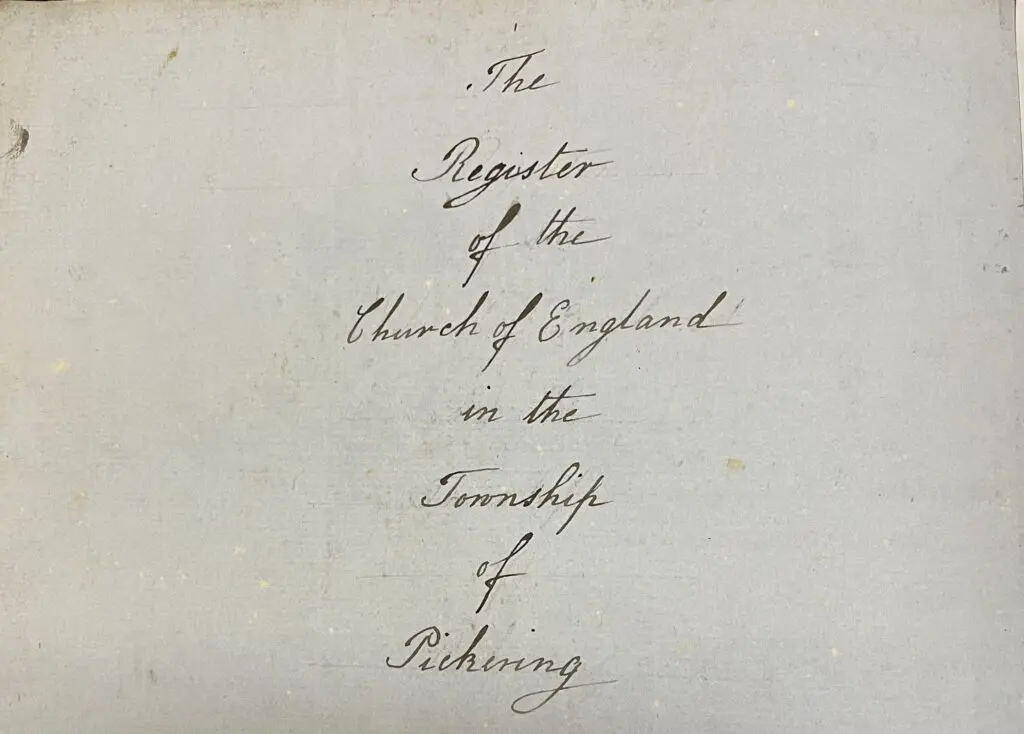
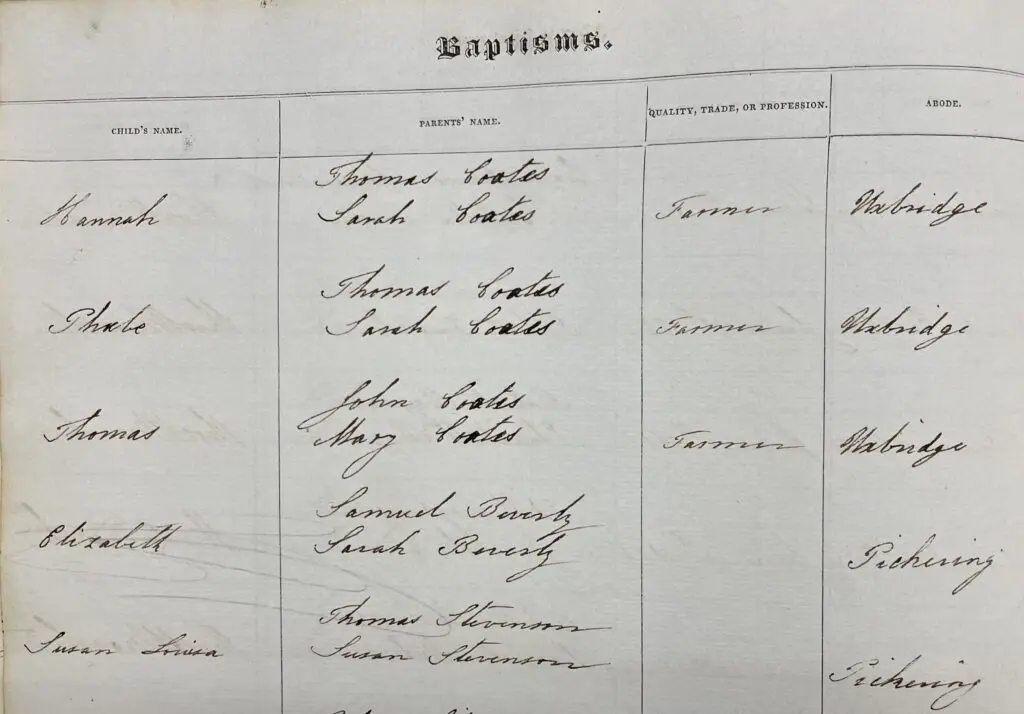
Entries in the register for the township of Pickering for baptisms in Uxbridge.
Y – St. Aidan, Young’s Point
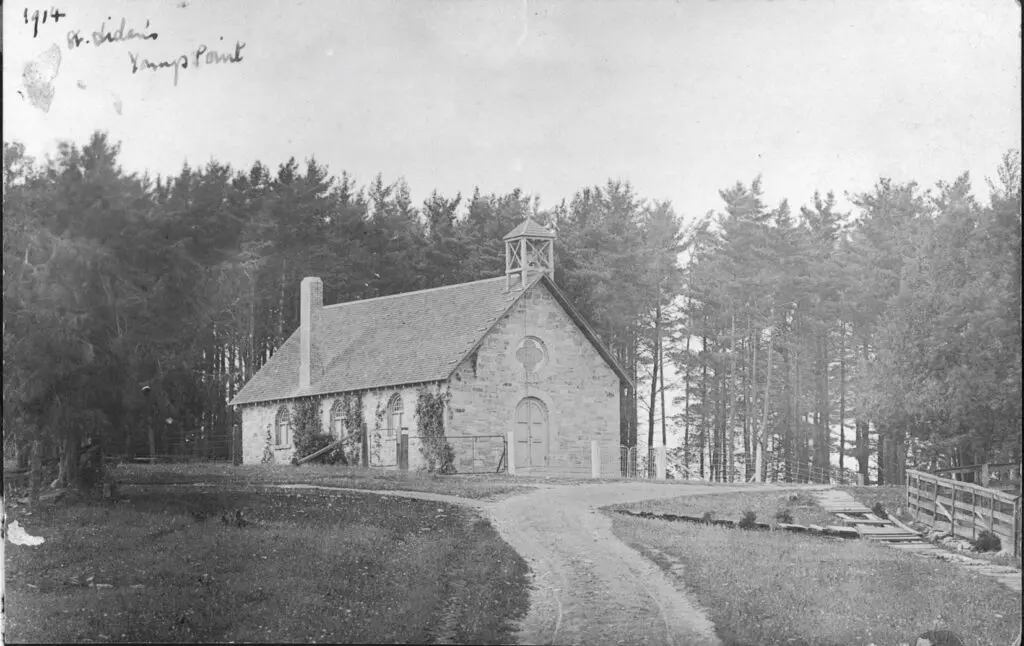
For some congregations that have existed in more rural parts of the Diocese, there can be few records in the Archives. In the case of St. Aidan, Young’s Point, we have only a handful of records specific to this congregation, as well as a few early records for the Parish of Stoney Lake, of which St. Aidan’s was part.
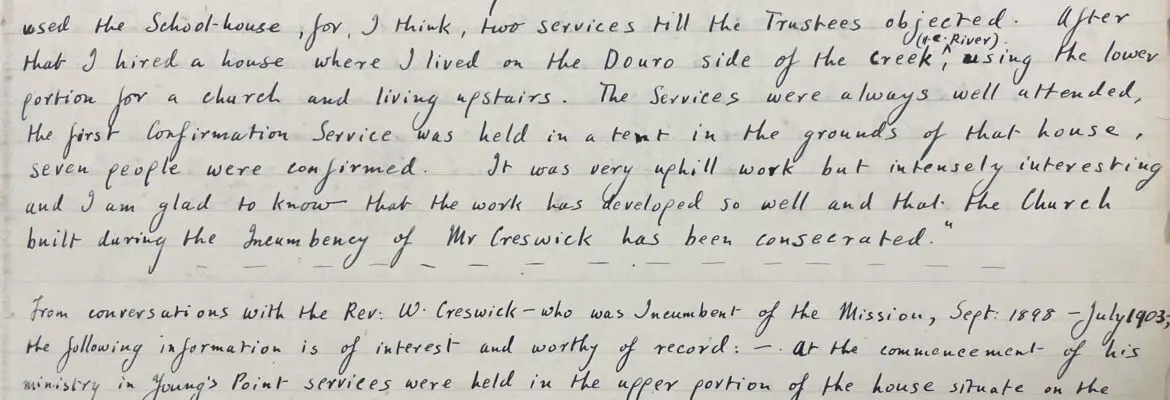
Among the records on deposit is the parish register for St. Aidan’s, which includes information about the early history. This was entered by the Rev. John Hughes, who was rector of the Parish of Stoney Lake from 1921-1924. During his time at the parish, he connected with the two earliest priests to minister to the people of Young’s Point. On Nov. 5, 1921, he entered information extracted from a letter written to him by the Rev. F. Hartley, rector of Holy Trinity, Haultain from 1894-1898. The recollections of Mr. Hartley note that he began ministering to the residents of Young’s Point in 1894, while he was in charge of Holy Trinity, Haultain, and that he was the first Anglican service to the community. During the four years that he provided services in Young’s Point, the community worshipped above the blacksmith’s shop, in a schoolhouse and in a home that he rented.
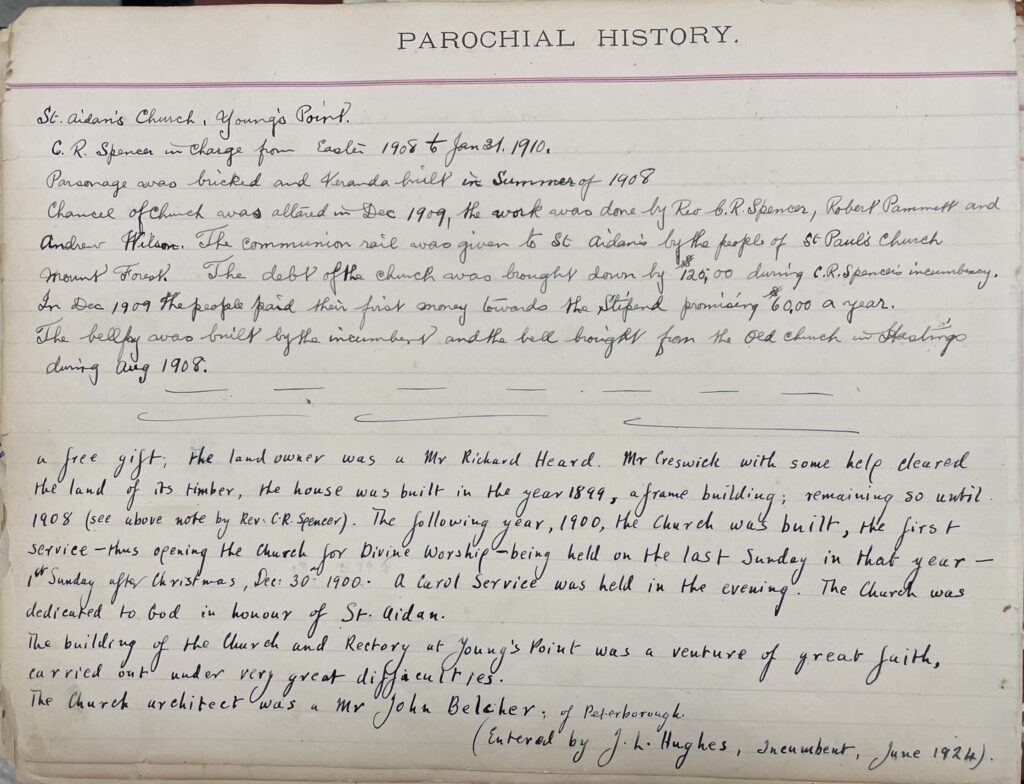 The date that the church was built is a little uncertain. An account by the Rev. Creswick as entered into the parish register by Mr. Hughes in June 1924 suggests that the church was completed in 1900 and the first service held on Dec. 30, 1900. Two other sources suggest the first service in the new church may have occurred earlier in 1900. First, there are four entries at the beginning of the register for baptisms of children of Edward and Ettie Wilson between January 1899 and September 1904. These were entered into the register on April 6, 1914, by the lay reader, William Wrixon. The baptism in 1899 is indicated to have taken place at home, while the next three are indicated to have taken place at St. Aidan’s, the first taking place on May 20, 1900, and conducted by Bishop Sweatman.
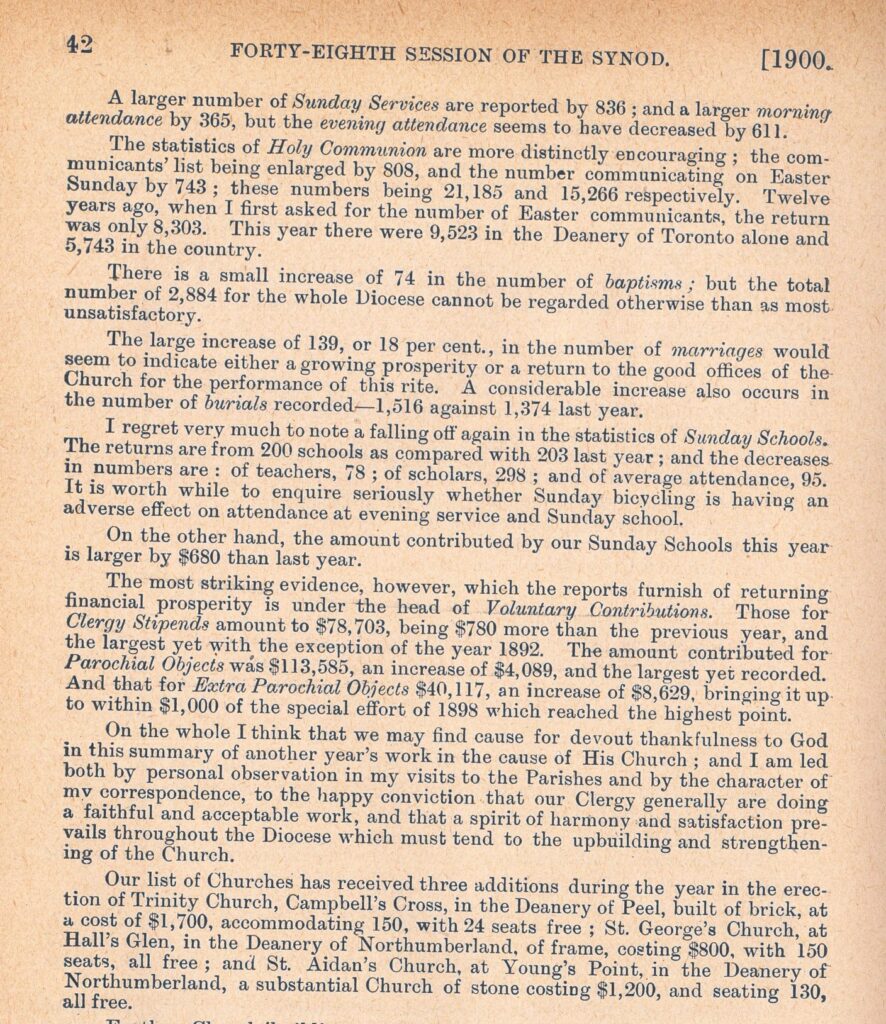 Then in the Synod Journal for 1900, in the bishop’s address Bishop Sweatman notes that St. Aidan’s church was built in the last year. As the Synod in 1900 was held before Dec. 30, 1900 it is possible that the church had its first service prior to Dec. 30, 1900.
Z – Zany
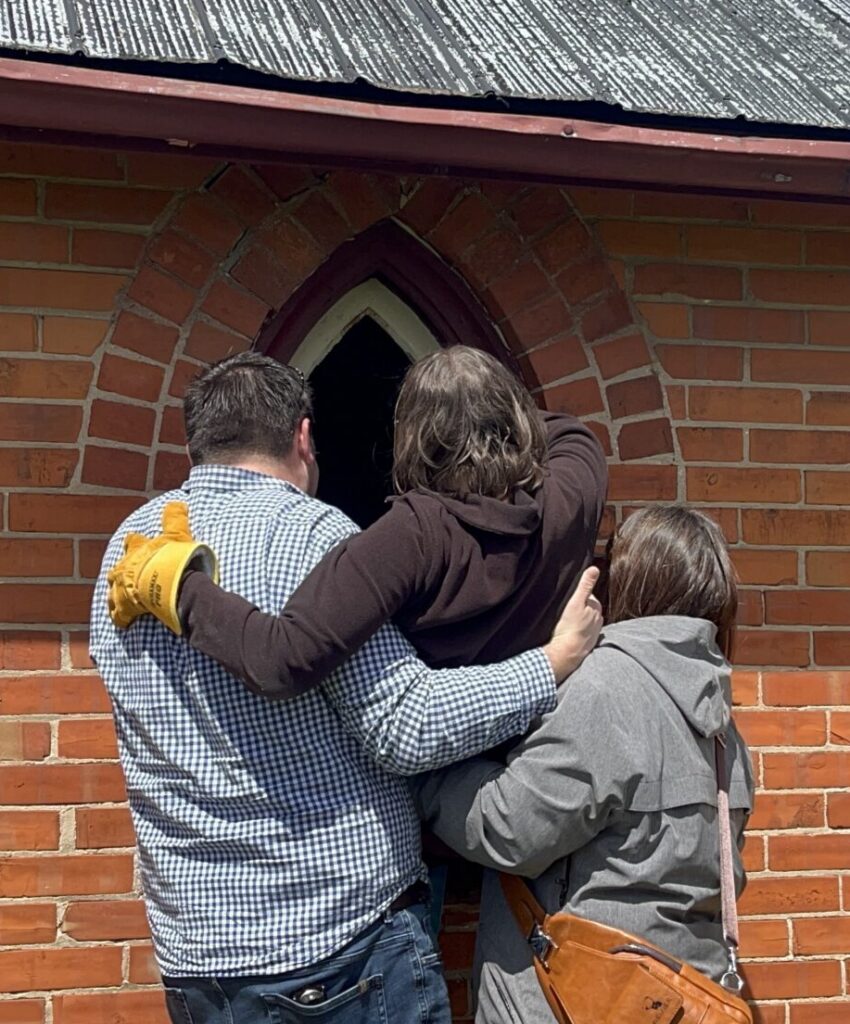
There are times that our attempts to ensure that records from closed churches are transferred to the Archives become a little zany. Last year we visited a church that had been closed since 1998, and on discovering that the key was missing we explored other options for getting inside.
Removing the plywood from a boarded up sacristy window, we discovered that it had been boarded because the window was no longer there, allowing us to get into the church building with a little imagination. With the assistance of the property team, I was able to be hoisted through the window and open the door from the inside. It was a totally worthwhile zany adventure when we discovered a handful of records from the 1940s.
