
We’re joining the Archives of Ontario in its month-long #ArchivesAtoZ campaign again this year! The aim is to increase the public’s awareness of archives and their collections. We’ll be sharing four posts throughout this month showcasing items from our holdings or providing information about Archives terminology based on each letter of the alphabet.
A – Archeion and All Hallows
We start this Archives A-Z off with a bang and two As to recognize. While the Diocesan Archives does not have its own online database, one of our major projects in 2026 is to add information about our collections to Archeion. This is a database hosted by the Archives Association of Ontario (AAO), which can be used by any archive that is an AAO member institution to add information about their collections. The first parish to be added to our listing is All Hallows, Toronto.
All Hallows Church began as a mission church of St. Saviour, Toronto, with the first service held in a school portable on Palmer Avenue on Dec. 17, 1913. Services in the first year of the mission’s existence were mainly conducted by lay readers from Trinity College. In June 1914, the Rev. H.R. Mockridge was appointed assistant curate at St. Saviour’s and given responsibility for this mission, with his first service at the mission held on All Saints Day in 1914.
The new mission received considerable support from the Sisterhood of St. John the Divine (SSJD). In 1915 the Sisters decided to erect a building in the district that would serve as worship space for All Hallows and a mission house for their work in this developing area of the city. The multi-purpose structure was begun in May 1915 and stood at 363 Main St. Bishop Sweeny blessed and dedicated the completed mission house on Sept. 11, 1915.
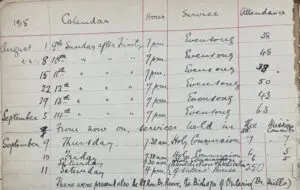

Entries in the Vestry book for All Hallows showing the he dedication of the Mission House 1915.
In June 1919, the Sisters decided to carry on their work in the mission from their convent on Major Street; the mission house became the residence for the priest-in-charge of All Hallows mission. On Sept. 27, 1920, ground was broken for a new church building at 393 Main St., and the building completed and dedicated in 1923. The Archives holds the vestry book (service register) for these early years, which include details about the services on these memorable dates.
Ultimately, All Hallows amalgamated with the church of St. Columba in 1990 to become the Church of St. Columba and All Hallows, worshipping in the building of the former St. Columba.
B – St. Barnabas, Halton Street
The Diocesan archives hold records for over 350 congregations and parishes. Some of those congregations closed more than 50 years ago and few people may know or remember that the congregation ever existed. St. Barnabas, Halton, is one such church, as it closed in 1971.
An entry in Bishop Sweatman’s journal dated Feb. 10, 1885 notes the creation of the new parish of St. Barnabas, Halton Street. For the first two years, members met in a rented Reformed Episcopal chapel, with land purchased for a church in 1886. The church was completed the following year, and the first service was held on May 1, 1887. The church was then dedicated on June 11, 1887.
The congregation grew steadily, and by 1910 the church needed to be enlarged, and a bell tower, basement and electricity were also added. By 1950 all debt had been paid off, and the church was consecrated on November 2nd of that year.
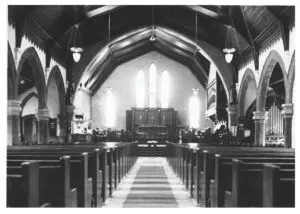
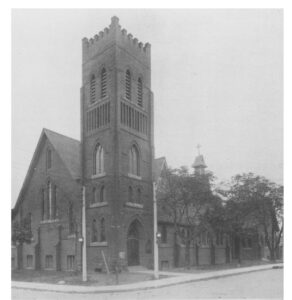
Unfortunately, over the next 20 years the neighbourhood underwent significant changes and membership began to dwindle. By the late 1960s, the buildings were in disrepair, but with no money to complete necessary work it was decided to sell St. Barnabas’s property and invest the money. The hope was that the investments would generate enough income to support the work of the congregation going forward. Arrangements were made to worship out of Wesley United Church, located at the corner of Dundas Street West and Ossington Avenue, and to share space on a trial basis for one year with the possibility of renewal.
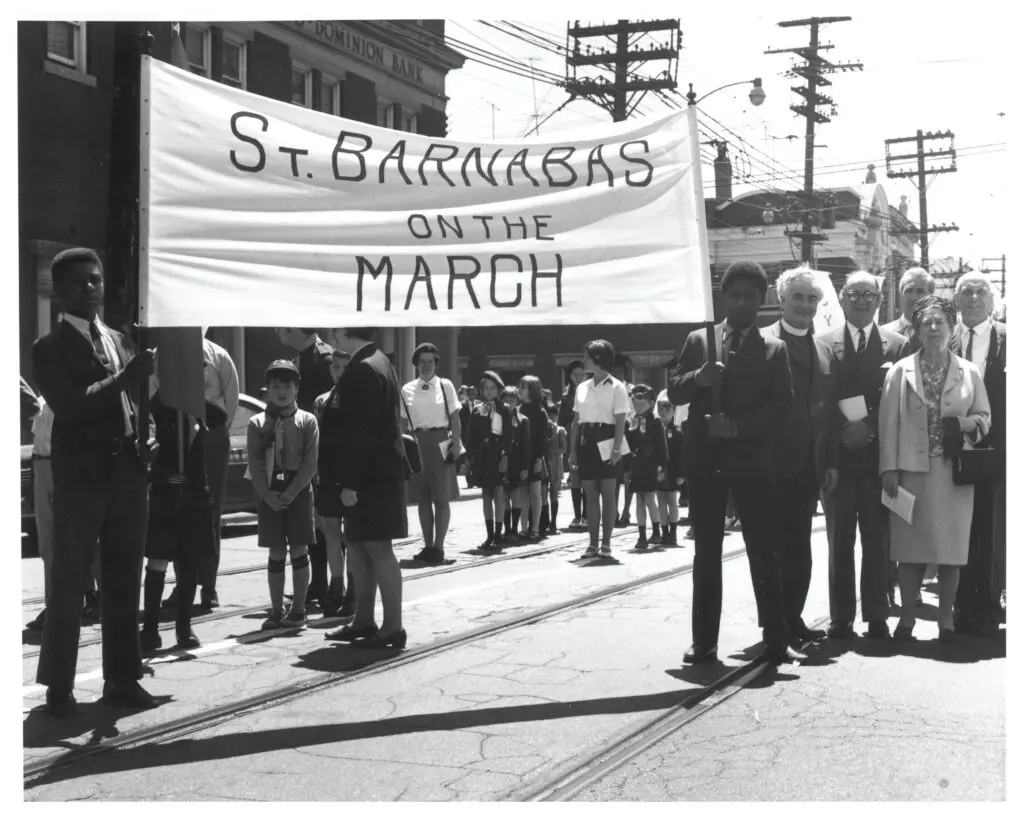
On June 14, 1970, the 85th anniversary of its founding, St. Barnabas closed its doors, and the congregation held a processional march “St. Barnabas on the March” to its new home at Wesley United. The partnership did not pan out, and on April 24, 1971, St. Barnabas was disestablished.
We give thanks to members of the Archives Committee, which was established in 1956, who ensured that some of the vital records from that parish ended up in the Archives. As a result, the Diocesan Archives holds the parish registers recording baptisms and marriages from 1885 and burials from 1909. There is also a small selection of advisory board minutes, service bulletins, newsletters and photographs.
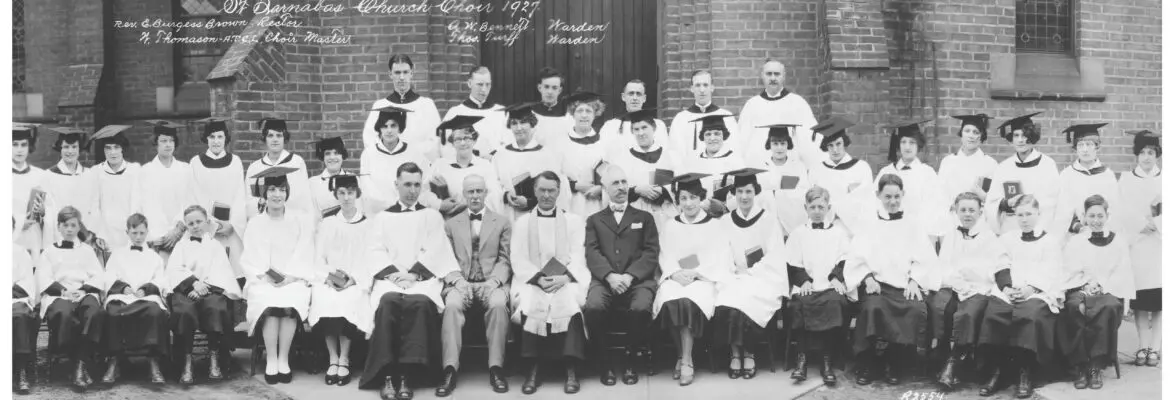
Amongst the photographs that we hold for St. Barnabas is one that was given to the Archives by the Rt. Rev. George Snell, taken around 1931 of the church choir. He is seated in the front row next to the rector, and may have been taken at his ordination as transitional deacon, as he was attending St. Barnabas, Halton when he was ordained a deacon in 1931.
Almost 40 years later, when the church closed its doors in 1970, he was the Bishop of Toronto. While he was unable to attend the closing service due to a prior commitment at another church, he did arrive in time for the processional to Wesley United, which, as it happens, had been the church that one of his grandfathers had attended. The Archives also has photographs from this occasion, as well as the write-up in the September 1970 edition of The Anglican, where Bishop Snell noted, “We do not regard any building made of bricks and boards as the Church of God. The Church of God is the people of God.”
C – Consecration certificates
A church consecration certificate documents the sentence of consecration given under the hand and seal of the bishop. It may take years after a church is built for it to be consecrated, as the church must be free of debt and the congregation must petition the bishop to consecrate the church, confirming that it is debt free. In some cases, a church may never be consecrated even if it has paid off all debt, because so much time has passed that the congregation assumes the church has already been consecrated.
The Diocesan Archives holds a number of consecration certificates signed by the various bishops over the years from 1839, when the Diocese of Toronto was set apart, until present. Prior to that, any church that was consecrated was consecrated by the Bishop of Quebec. In some cases, a church has been consecrated but we don’t have the certificate, either because it was consecrated prior to 1839 or a copy was not kept. In some cases, we are able to find other evidence to support the consecration, such as it being recorded in the book of Episcopal Acts if it occurred after 1867, and sometimes in the Synod Journals.
Many churches were not consecrated for at least several years after being built; however, Holy Trinity, Trinity Square was able to be consecrated in 1847, the same year that it was opened. Holy Trinity was built following the gift of an anonymous donor (later revealed as Mary Lambert Swale of Settle, England). Mrs. Swale had stipulated that all pews were to be free and unreserved. This donation allowed the church to be debt free from the start.

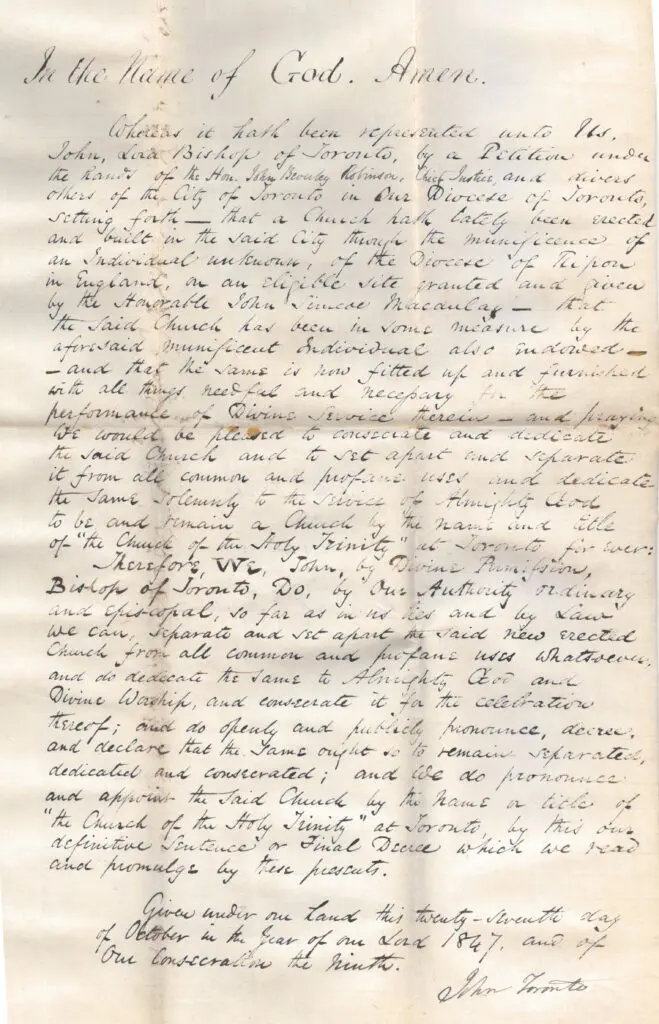
Petition for Consecration Sentence of Consecration (Consecration Certificate)
D – Deaneries
The Diocese of Toronto has had deaneries in place since at least 1859, though the details of the deanery names and Rural Deans prior to 1869 are not well documented. From 1869 onwards, the information can be found in the Synod Journals. Deaneries were originally called “rural deaneries,” and from 1869 to 1870 there were just five: West York, East York, Simcoe, Durham and Northumberland.
By 1888 there were 10 rural deaneries: Toronto, Peel, West York, East York, East Simcoe, West Simcoe, South Simcoe, Durham, Northumberland and Haliburton. There were further changes and additions of deaneries in 1925 when Durham and Northumberland were combined and Peterborough and Victoria were added. In 1956, shortly after the election of Bishop Wilkinson, there were additional changes, and the number of deaneries increased to 17.
With the change to the area system in the Diocese in 1980, the number of deaneries increased to 20 and became known as “regional deaneries” rather than “rural deaneries.” Today the Diocese of Toronto is split into 18 deaneries. The Archives holds records including correspondence and minutes from many of the deaneries, though these records are primarily from after 1956 when the Archives Committee was established. However, the Archives also holds minutes for the meetings of the Clerical Association of the Home & Simcoe Deaneries going back to 1859, as well as the Deanery of Northumberland going back to 1869.


E – Emmanuel, Hanlan’s Point
Today the only Toronto Island church is St. Andrew by-the-Lake, but up until 1959 there was a second church located at Hanlan’s Point.
A worship service for the benefit of campers and cottagers on Hanlan’s Point was first held in 1895 under the auspices of the Brotherhood of St. Andrew. It seems that lack of planning prevented regular services continuing for that year, but beginning in 1896 services were held in the parlour of Hanlan’s Hotel every Sunday from the first Sunday of June to the last of August and sometimes into September. The congregation soon proved too large for the space, and the venue was moved to an outdoor pavilion. This site also proved inadequate, and the congregation moved to a rooftop garden over the ferry shelter.
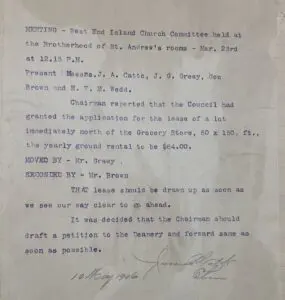
In 1905 a campaign by the West End Island Committee was undertaken to build a permanent church. Designed by architect Arthur Denison, the church, which was given the name Emmanuel Church, opened on July 8, 1906 on land leased from the city of Toronto.

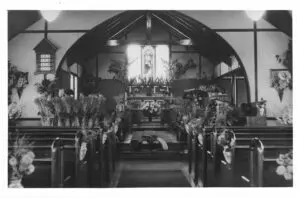
Canon Cody of St. Paul, Bloor Street officiated at the morning service, and Archdeacon Sweeny (later Bishop Sweeny) took the evening service. The services during the summer were most often presided over by theological professors or theological students. Some of those individuals went on to have more prominent roles in the Anglican Church, including Daniel Coggan, whose name can be found regularly in 1938 and then on a less regular basis between 1940 and 1942. At the time he was a professor at Wycliffe College but he became Archbishop of Canterbury in 1974.

For most worshippers it was a summer chapel, but some winter residents attended year-round. With no heating in the church, they blocked off the nave, put a portable stove at the front, and sat in the choir stalls for prayer. Redevelopment of the island in the late 1950s resulted in the end of a resident summer community and the last service was held on June 21, 1959. Over the years the church had received many memorial gifts and was well-appointed. Almost all the furnishings were transferred to the newly constructed Emmanuel Church, Richvale (Richmond Hill). One stained glass window was given several years earlier to St. Margaret, North Toronto.
The Archives holds the parish registers from 1906, service registers, vestry minutes and church committee minutes, including those of the West End Island Committee.
F – FaithWorks
This year marks the 30th anniversary of the creation of FaithWorks, and it is wonderful to see how well this program is still supported! FaithWorks was established in 1996 in response to cuts in government funding for key social services throughout Ontario. The first annual campaign kicked off in 1997, with a fairly tepid response; however, with changes in the program to allow parishes to retain 15% of funds raised for local outreach and 5% to go to each episcopal area for area outreach, FaithWorks began to flourish. The Archives holds records related to the start of FaithWorks in 1996 as well as copies of its posters and campaign materials for every year since 1997, when the first full year campaign was launched.


1997 Campaign poster
G – St. George, Cooper’s Falls

Cooper’s Falls is located near the northern boundary of the Diocese of Toronto. In fact, its location was so close to the border with the Diocese of Algoma that the land was originally deeded to the Bishop of Algoma by the Crown for five dollars on Nov. 24, 1884, a month after the church had been completed and the first service held, based on an article in the Orillia Packet & Times. The title to the land was finally registered and transferred to the Diocese of Toronto in July 1962.
The Archives & Property teams visited St. George, Cooper’s Falls in the summer of 2024 to document any memorials by taking photographs. This led to the altar being used at Synod 2025, with a photograph of one of the memorial windows projected on the wall behind. It was a beautiful way to remember this church that closed in 2009.


Next week we will share Archives Awareness H to M!
